
You just finished a typing test and the screen says 46 WPM. Is that a score to be proud of, or a sign you should be practicing more?
The short answer: yes, 46 WPM is a good typing speed. It sits above the commonly cited average of roughly 40 words per minute, it is fast enough for school, email and most everyday office work, and it comfortably clears the bar for many entry-level jobs. If you are aiming for specialist roles like data entry or transcription, 60 WPM or more is a better target, and the good news is that you are already most of the way there.
Table of Contents
But a single number never tells the whole story. Whether 46 WPM is “good” depends on your age, your goals, the type of test you took and how accurate you were. In this guide you will find a complete typing speed chart, what employers expect, how WPM is actually calculated, and a practical plan to move from 46 to 60 WPM and beyond.
Typing Speed Chart: What Is a Good WPM?
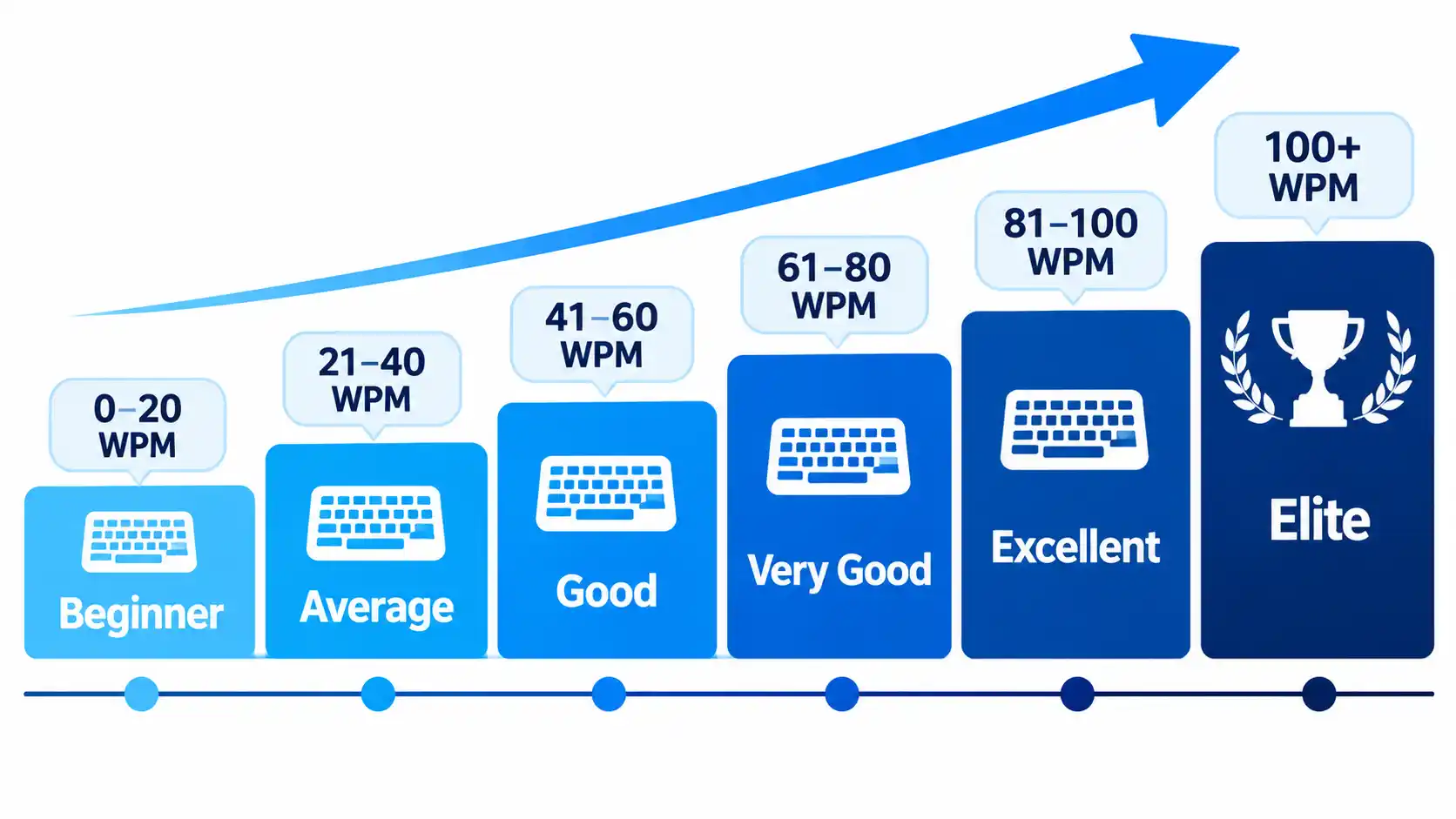
Use this chart as a quick reference. The labels are general guidelines drawn from commonly reported typing benchmarks, so treat them as a guide rather than an official standard.
|
WPM range |
Skill level |
What it usually means |
|---|---|---|
|
Under 20 |
Beginner |
Still learning where the keys are |
|
20 to 30 |
Below average |
Mostly looking at the keyboard |
|
31 to 40 |
Average |
Comfortable for emails and homework |
|
41 to 54 |
Good |
Above average and fine for most jobs |
|
55 to 69 |
Very good |
Strong for office and admin work |
|
70 to 89 |
Excellent |
Professional-level speed |
|
90 to 119 |
Advanced |
Faster than the vast majority of typists |
|
120 and above |
Elite |
Competitive typists and speed specialists |
As you can see, 46 WPM lands squarely in the “good” band. For a deeper look at benchmarks, read our full guide on what is a good typing speed and the breakdown of average WPM for typing.
Is 46 WPM Good Compared to the Average?
Most studies place the average typing speed for adults somewhere between 40 and 50 WPM, depending on the sample and the test used. Casual typists who never learned touch typing often land closer to 30 to 40 WPM, while people who type for a living usually reach 60 WPM or higher.
At 46 WPM you are right around, or slightly above, the average. That means you can already handle long emails, reports, chat messages and school assignments without feeling slowed down. The difference between you and a professional typist is usually not talent. It is technique: touch typing, rhythm and consistent practice.
Is 28 WPM Good?
28 WPM is below average, but it is also a very common starting point, especially if you have never taken a typing course. The usual reason for a speed in the high twenties is looking at the keys and using only a few fingers. Learning proper finger placement can lift most people into the 40s within a few weeks.
Is 55 WPM Good?
Yes, 55 WPM is a very good typing speed. It is faster than most people and meets the requirement for the majority of administrative and customer-facing roles. You are close to the professional range, and a bit of focused accuracy training can take you over 60.
Is 60 WPM Good?
Sixty words per minute is one of the most common targets in job listings, and it is a strong result. At this level, typing is no longer the bottleneck in your work. Your goal shifts from going faster to staying accurate and relaxed.
Is 75 WPM Good?
75 WPM is excellent. You type faster than most office workers, which is a real advantage for writing, programming, transcription and any job with heavy keyboard use. If you want to see how fast you can go, try our Champion Test and compare yourself on the global leaderboard.
Is 80, 100 or 180 WPM Good?
These speeds are extremely fast. 80 WPM and above puts you in the top tier of everyday typists, and 100 WPM is something only a small percentage of people reach. Speeds near or above 180 WPM are typically seen in short bursts from competitive typists, not in normal sustained work.
Good WPM by Age
Typing speed changes across life stages. These ranges are general estimates, and individual results vary widely with practice.
|
Age group |
Typical speed range |
A good target |
|---|---|---|
|
Children (7 to 11) |
10 to 25 WPM |
25 WPM |
|
Teens (12 to 17) |
25 to 45 WPM |
45 WPM |
|
Adults (18 to 50) |
35 to 55 WPM |
55 to 60 WPM |
|
Adults (50+) |
25 to 45 WPM |
40 to 50 WPM |
By these ranges, 46 WPM is a good result for a teenager and a strong result for an older adult.
What Typing Speed Do Employers Expect?
Requirements differ by employer, so always check the job listing. These are typical ranges.
|
Job type |
Typical WPM expected |
|---|---|
|
Customer service |
35 to 50 |
|
Administrative assistant |
40 to 60 |
|
Data entry |
50 to 80 |
|
Content writer or editor |
50 to 70 |
|
Transcription |
65 to 80 and above |
|
Government and clerical exams |
Varies by exam and language |
If you are preparing for a hiring test, our guide on how to pass a typing test for a job interview covers speed, accuracy, posture and test-day nerves.
How Is WPM Actually Calculated?
Understanding the math helps you read your score correctly. Most typing tests treat a “word” as five characters, including spaces. This keeps the measurement fair, because a long word counts for more than a short one.
There are two versions of the score:
- Gross WPM counts everything you typed, divided by five, then divided by the minutes taken.
- Net WPM takes your gross speed and subtracts uncorrected errors. This is the more honest number and the one most employers care about.
For example, if you type 250 characters in one minute, your gross speed is 50 WPM. If you left four mistakes in the text, your net speed drops. That is why a fast but sloppy typist can score lower than a steady, accurate one.
Why Your Score Changes From Test to Test
If you tested 46 WPM on one site and 52 on another, nothing is wrong. Scores vary because of:
- Text difficulty. Common words are faster than paragraphs full of punctuation or numbers.
- Test length. A 60-second sprint usually scores higher than a five-minute test, because you tire over time.
- Error rules. Some tests stop you until you fix a mistake, while others only penalize it.
- Your keyboard and layout. A familiar keyboard gives better results. If you are curious about alternatives, see our guide to the fastest keyboard layouts in 2026.
For the most reliable picture, take three tests on different days and average your results.
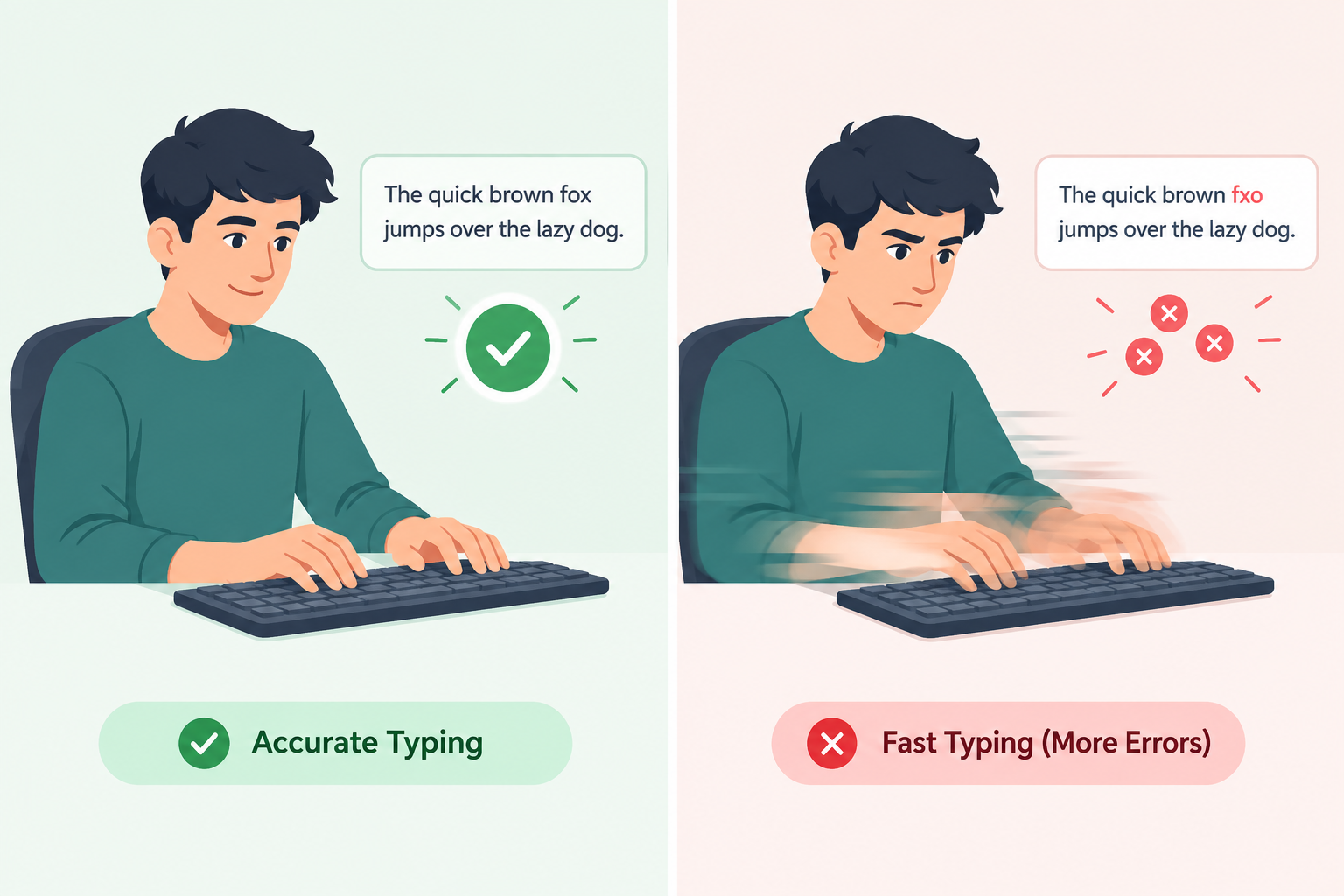
Accuracy Matters as Much as Speed
A typist who scores 50 WPM at 98% accuracy is usually more productive than someone at 65 WPM with 90% accuracy, because fixing mistakes eats up time. A good habit is to reach 95% accuracy or better first and build speed after that. We explain the trade-off in detail in our article on typing accuracy vs. speed.
How to Go From 46 to 60 WPM
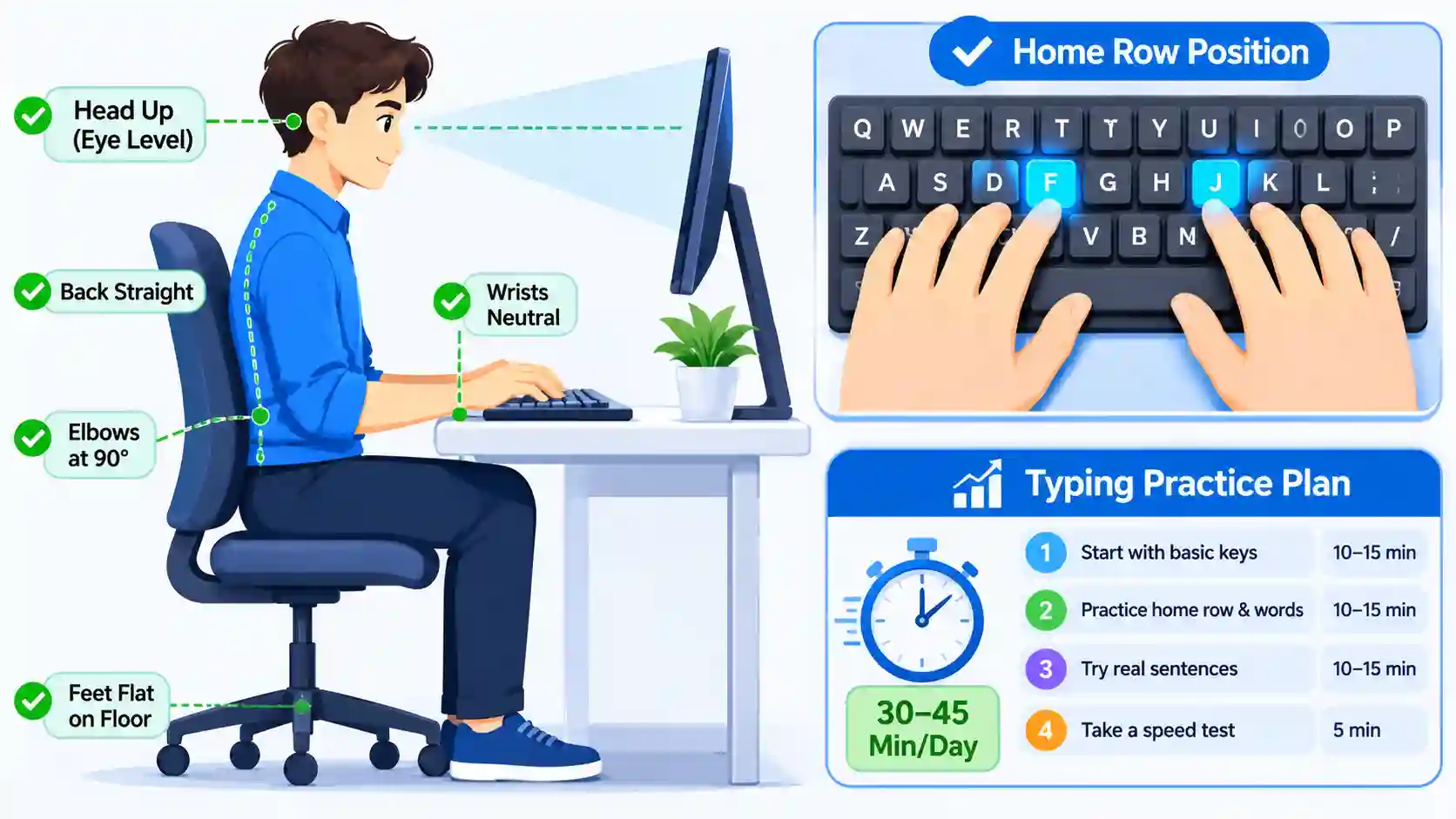
The jump from 46 to 60 WPM is very achievable. Most people can do it in about six to eight weeks with 15 to 20 minutes of daily practice. Here is a simple plan.
|
Week |
Focus |
Daily routine |
|---|---|---|
|
1 to 2 |
Technique |
Practice home row and stop looking at the keys |
|
3 to 4 |
Accuracy |
Slow down and aim for 97% or higher |
|
5 to 6 |
Rhythm |
Type common words and short paragraphs steadily |
|
7 to 8 |
Speed |
Take timed tests and push your pace gradually |
Key habits that make the difference:
- Commit to touch typing. Keep your fingers on the home row and let muscle memory do the work. Our touch typing guide walks you through the technique step by step.
- Practice a little every day. Short, regular sessions beat a single long weekly session.
- Fix your posture. Keep your wrists neutral, elbows near 90 degrees and your screen at eye level to avoid fatigue.
- Slow down to speed up. Rushing builds bad habits. Smooth, accurate typing becomes fast typing naturally.
- Work on your weak keys. Notice which letters cause errors and drill them.
- Track progress. Test once a week and write down your score so you can see improvement.
Struggling with the process itself? Our article on why typing is so hard explains the coordination behind it and how to stop repeating mistakes. You can also start our free English typing lessons right now.
Typing Speed in Hindi, Urdu and Chinese
Speed benchmarks are different for other languages, because scripts, keyboard layouts and word lengths vary. If you type in Hindi, check our Hindi typing keyboard guide and practice with the Hindi lessons. We also offer Urdu lessons and Chinese lessons, so you can build skills in your own language.
Check Your Typing Speed Right Now
Ready to see where you really stand? Take a free test and get your WPM and accuracy in about a minute:
Create a free account to save your progress and join the leaderboard.
Frequently Asked Questions
Is 46 WPM good for a beginner?
Yes. Beginners usually start at 20 to 30 WPM, so 46 WPM shows you already have solid fundamentals.
Is 46 WPM fast?
It is above average but not considered fast. Most people consider 70 WPM and above to be fast.
Is 46 WPM good enough for a job?
For many customer service and entry-level office roles, yes. Data entry and transcription usually ask for 60 WPM or more.
Is 55 WPM good?
Yes. It is a very good speed that meets the requirements for most administrative positions.
Is 28 WPM bad?
It is below average, but it is easy to improve with touch typing lessons and a few weeks of regular practice.
How long does it take to reach 60 WPM?
Most learners get there in about two to four months of consistent daily practice, and some faster if they already touch type.
Does the keyboard layout change my WPM?
Slightly. Practice matters far more than the layout, but some typists enjoy alternatives like Dvorak or Colemak.
What is a good typing accuracy?
Aim for 95% or higher. Many employers prefer 97% to 98%.
Final Thoughts
So, is 46 WPM good? Absolutely. You are above the average, you have the skills for most everyday and office work, and you are within reach of the 60 WPM mark that many employers look for. The next steps are simple: focus on accuracy, practice a little every day, and track your progress.
Head over to our typing tests to measure your speed today, then come back in a month and see how far you have come.